
I had a mixed feeling two days ago when finding one year had passed away since I came to England. As my house mates were about to leave, they reminded me of some tourist attractions in Exeter that I had no opportunity to pay a single visit in the past year. The unwitting lapse of time galvanized me into action.
Although unbeknown to most people in China, Exeter still bears its fame as an ideal city for British families to spend their weekends. As the capital of Devon County, Exeter is regarded to be a transfer stop for those who want to take a breath of the remote rocks and capes in the very southwest corner of Cornwall. Many people will go to see the renowned Exeter Cathedral located in the city centre as its main sight. The church has experienced a radical refurbishment during the past year when two big scaffolds were attached to the front gate, which partly prevented my visit in those months. Fortunately, the overhaul project was finally close to complete and I can take a detailed look at this magnificent building at length.
Founded in 1112, the cathedral had been constructed for more than two centuries to become a towering edifice lying in the square we can see nowadays. The grand façade is carved with exquisite stone figures of religion characters with vivid expressions hooded in artificial web as a preserve measure to fend off weathering. Despite a lack of steeples typical in other churches, the main corridor and the flank archway as well as the marble sculpture of bishop sitting aside, still constitute a picturesque panorama of medieval style.
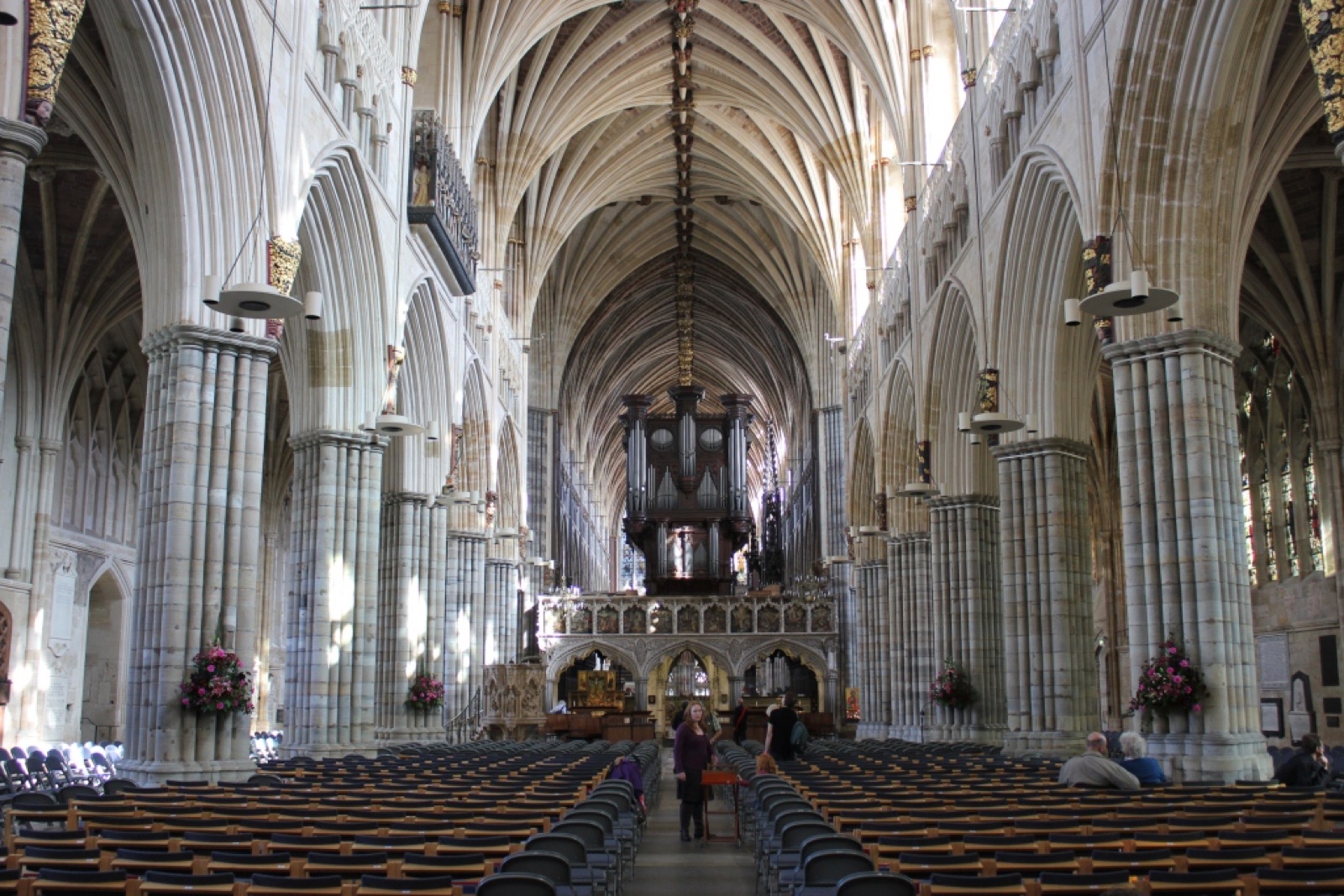
I was soon standing agape at the marvellous pillars and domes in one peaceful afternoon. The interior decoration was even more careful in comparison with its exposed wall as I saw all connections between pillars and ceilings were gilded meticulously with patterns of different sorts. It is said that Exeter Cathedral is proud to have the longest uninterrupted medieval vaulted ceiling in the world. Therefore, when you chant in the church, the sound will resonate both stately and elegantly throughout the winding corridor. Erecting amid the glorious hall, the church organ has made it better. It was lucky to witness a children’s choir rehearsing with the aid of this instrument, whose hymn was one of the best I had heard in my life. Those cute kids, with their crimson robes, listened carefully to the instruction of the avuncular priest and I couldn’t help tittering at the ridiculous situation when he gesticulated exaggeratedly. The inscriptions on the walls around are another stimulating object to see. They are all epitaphs of bishops or priests working in Exeter or those who had paid contribution to the preach course in the vicinity with their remains preserved in the vault. I saw the stone coffins of many eminent figures as well, such as the founder of Exeter College in Oxford University, who reposed in tranquillity at one corner of a flank. Seeing that the preserve work of the cathedral library was still in proceeding, its large collections, including the well-known Exeter Book, the earliest poetry anthology in England, had not opened to the public yet. What a pity!