Transport Production Process Designs Through SAP Cloud Transport Management
Clear, user-centered documentation that explains how to transport SAP Digital Manufacturing production processes via SAP Cloud Transport Management, turning a complex, multi-system setup into a reliable, auditable, and repeatable enterprise workflow.
Context#
In SAP Digital Manufacturing, users typically design and debug production processes in a test system before moving them to quality or production systems. While the Production Process Designer provides a basic export and import mechanism, many customers require a more standardized, auditable, and scalable transport process—especially in enterprise landscapes with multiple systems and strict governance requirements.
By integrating SAP Digital Manufacturing with SAP Cloud Transport Management, customers can transport production process designs through a centralized middleware. This approach not only streamlines the transport workflow but also lays the foundation for transporting additional configuration objects in the future.
My Role#
As the user assistance developer, I transformed developer-oriented materials—including concept slides, technical wikis, and internal architecture notes—into clear, user-facing application help. This process involved extensive preparation: I first mapped the end-to-end transport workflow, identified knowledge gaps, and created a content plan that balanced conceptual clarity with procedural accuracy. I conducted multiple review cycles with developers, product managers, and UX designers to validate technical details, confirm system behavior, and refine the user journey. I also built and tested sample transport scenarios myself to ensure that every instruction reflected real system outcomes.
Through this project, I strengthened my ability to translate complex technical architectures into accessible documentation, honed my information design and visual communication skills by creating diagrams and structured tables, and deepened my understanding of SAP Cloud Transport Management and SAP Digital Manufacturing integration. My responsibility was to bridge the gap between system architecture and user action, ensuring the documentation was accurate, actionable, and aligned with real user workflows.
Key Challenges#
- The setup is a one-time task but technically complex, involving SAP Business Technology Platform and SAP Cloud Transport Management.
- Critical principles (such as transport direction, user ownership, and version handling) must be understood to avoid data loss or inconsistent system states.
- The end-to-end workflow spans multiple systems: export from Production Process Designer, transport orchestration in SAP Cloud Transport Management, and validation in the target system.
- User and version management behaviors are non-obvious and require precise explanation using structured tables and scenarios.
Deliverables#
- A main topic and a dedicated subtopic in the Application Help for Production Process Designer
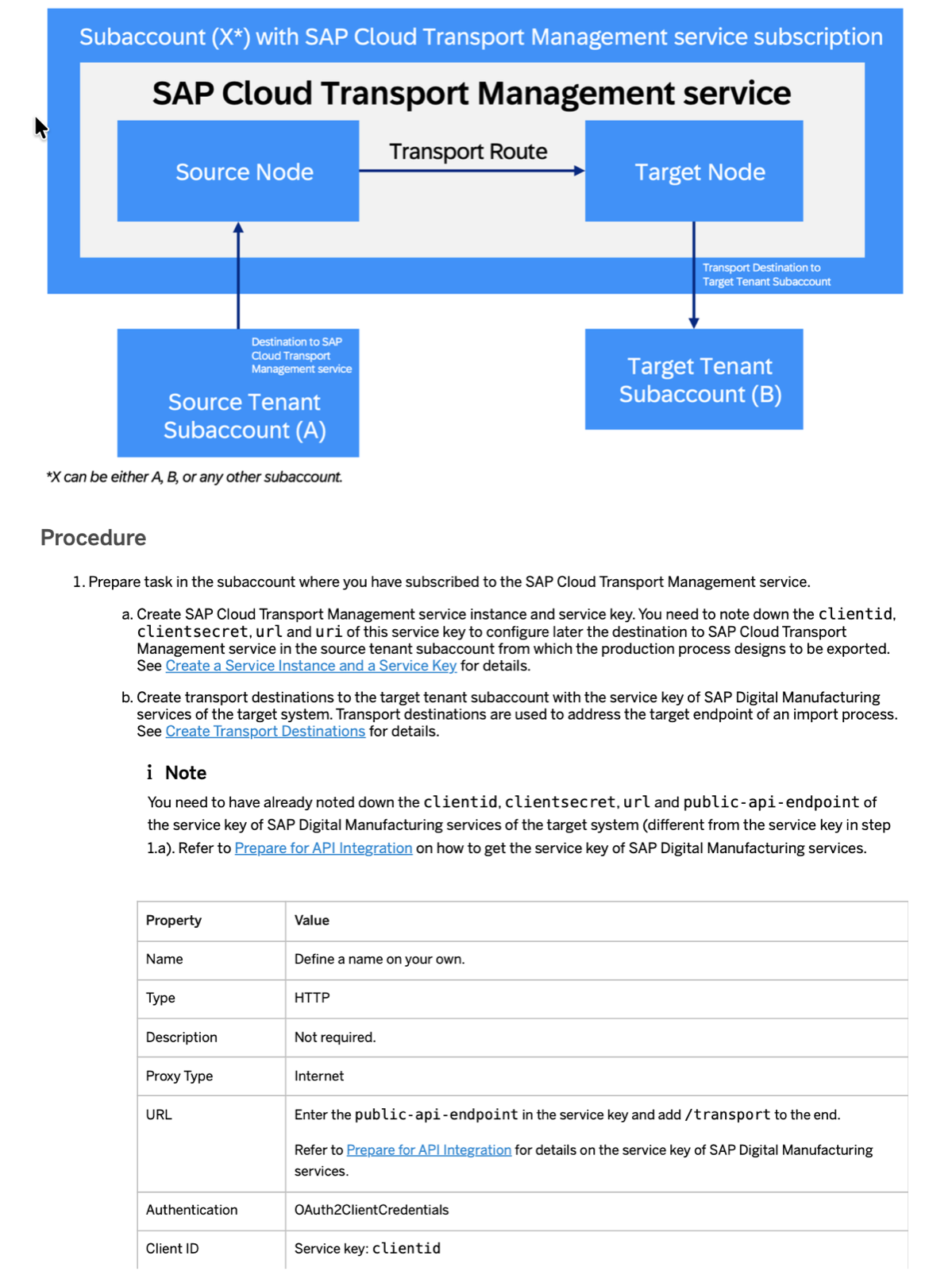
- Architecture diagrams illustrating source systems, transport nodes, and target systems
- Detailed tables explaining user ownership, version behavior, and system outcomes during initial and subsequent transports
These elements work together to guide users from conceptual understanding to successful execution.
Impact & Business Value#
- The documentation is consistently among the most-read topics in the application help, enabling users to perform transports independently.
- It serves as the single authoritative reference shared with customers when support tickets are raised, significantly reducing resolution time and preventing repeat inquiries.
- The clear structure and step-by-step guidance reduce misconfiguration risk and improve customer confidence during system upgrades.
- The content has been reused as a trusted knowledge source for the Joule AI chatbot, extending its value beyond documentation into AI-assisted support.
Download: Documentation Sample (PDF)
Reference: Transport Production Process Designs Through SAP Cloud Transport Management — SAP Help Portal ↗